Pattern Recognition, Order Flow, Pressure and Market Context
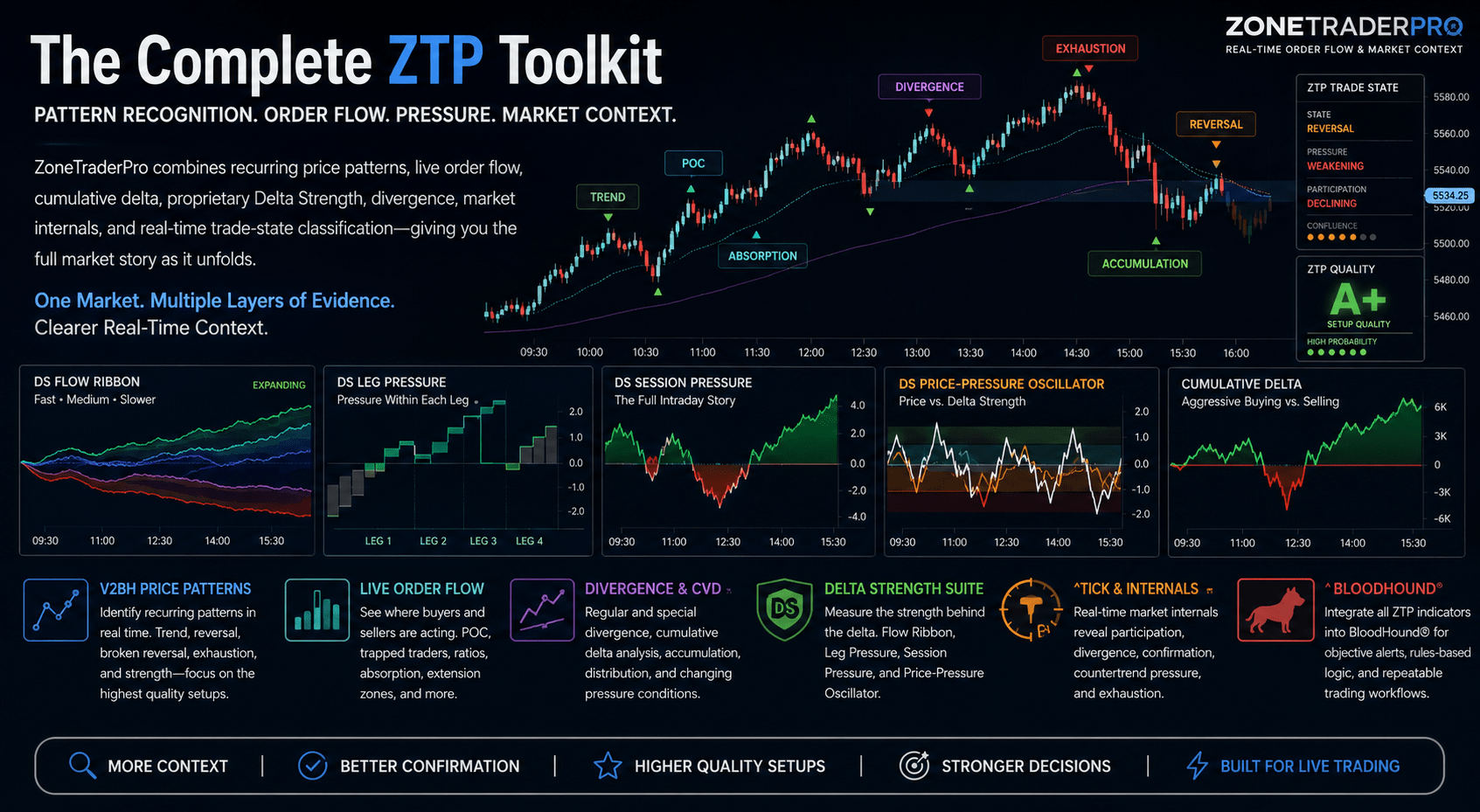
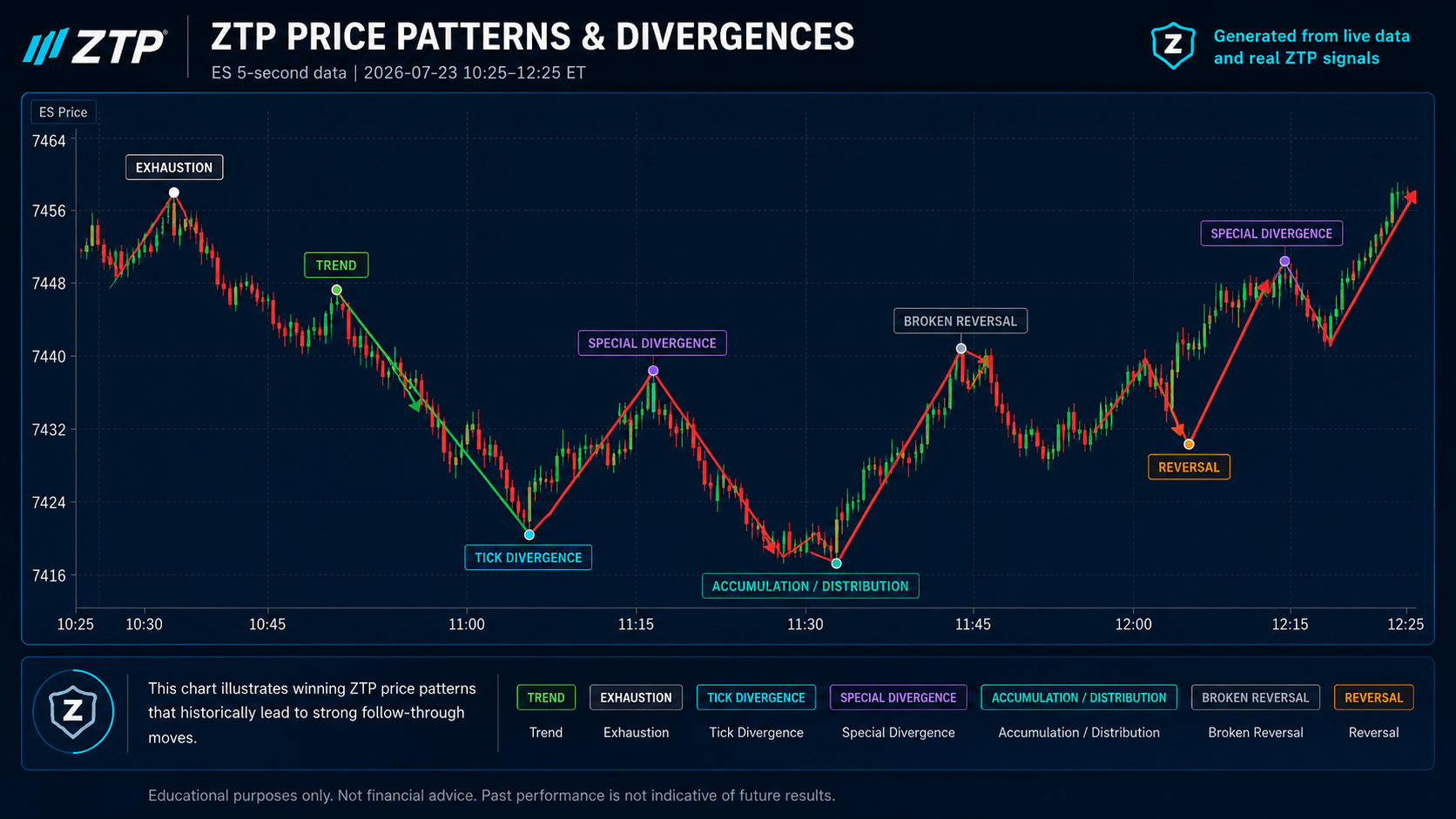
ZoneTraderPro begins with recurring price patterns. The V2BH Price Pattern Engine identifies trend, reversal, broken-reversal, exhaustion, and strength patterns as they develop—and helps filter the results so traders can focus on the strongest setups rather than every market swing.
ZTP then evaluates those patterns through additional independent layers, including live order flow, cumulative delta, Delta Strength, divergence, accumulation and distribution, ^TICK participation, and broader market internals.
First identify the pattern. Then determine whether the market evidence supports it.
ZTP Price Pattern Engine
Identify Recurring Price Behavior—and Focus on the Best Setups
The V2BH Price Pattern Engine analyzes live price movement to identify recurring market structures that have appeared repeatedly across historical and real-time charts.
Rather than labeling every pivot or treating every price swing as an opportunity, V2BH classifies the developing pattern and evaluates the quality of the setup within its surrounding market context.
The objective is not to produce more signals. It is to recognize when a meaningful price pattern is forming and distinguish stronger, higher-quality opportunities from ordinary chart movement.
A price pattern becomes more valuable when other independent measurements support it. Price Patterns can be evaluated alongside:
Live order flow
Cumulative delta
ZTP Delta Strength
Regular and special divergence
Accumulation and distribution
Exhaustion
^TICK participation and market internals
When the pattern and the supporting evidence agree, ZTP can elevate the setup. When the evidence is weak, conflicted, or late, the pattern can be downgraded or excluded.
V2BH is designed to identify repeatable price patterns—and help traders concentrate on the highest-quality setups rather than every possible setup.
Divergence, Cumulative Delta & Changing Pressure
ZTP Divergence, Cumulative Delta, Accumulation & Distribution
Price can continue making new highs or lows even after the internal pressure behind the move begins to change. ZTP compares price structure with cumulative delta and proprietary divergence classifications to identify when buyers or sellers are no longer producing the same result with the same force.
The system classifies regular divergence, special divergence, accumulation, distribution, confirmation, and exhaustion in real time. These conditions do not automatically predict a reversal. They reveal that the quality of the move has changed—giving traders important context before deciding whether the market is continuing, weakening, being absorbed, or preparing to transition.
ZTP Delta Strength Suite
See the Strength Behind Delta—not just the delta itself
ZTP Delta Strength is a 100% original ZTP concept designed to evaluate the quality and strength of the pressure behind delta. It works alongside V2BH price patterns, cumulative delta, divergence, accumulation and distribution, exhaustion, and ^TICK classification to show whether the internal evidence is confirming the move—or beginning to separate from price.
Traditional delta reports what traded. ZTP Delta Strength is designed to reveal the strength behind the move.
The suite presents that evidence through four coordinated views:
DS Flow Ribbon — Shows pressure expansion, compression, transition, and renewed acceleration. DS Leg Pressure — Compares the strength of one confirmed price leg with the next. DS Session Pressure — Preserves the complete intraday pressure story from open to close. DS Price-Pressure Oscillator — Reveals confirmation, accumulation-like behavior, distribution-like behavior, and potential exhaustion when price and DS move out of sync.
ZTP ^TICK Classification & Market Internals
See Whether the Broader Market Is Confirming the ES Move
ES can continue rising while participation across the broader market is weakening—or remain under pressure while internal buying begins to improve. ZTP analyzes live NYSE ^TICK behavior to show whether market participation is aligned with price, pushing against the move, or reaching an unusually extended condition.
Rather than treating every high or low ^TICK reading as meaningful, ZTP classifies the reading within its recent context. The system identifies trend-aligned participation, countertrend pressure, ^TICK divergence, changing internal bias, and exhaustion-like extremes—helping traders distinguish a broadly supported move from one that may be losing internal strength.
ES shows where price is moving. ZTP ^TICK Classification shows whether the broader market is participating.
Trend confirmation — broader participation supports the ES move
Countertrend pressure — internal activity begins pushing against price
^TICK divergence — price makes progress without comparable participation
Extended conditions — market internals reach an unusual contextual extreme
Changing bias — participation strengthens or deteriorates as the move develops
ZTP turns raw ^TICK readings into a real-time market-internals classification—not another isolated number or overbought/oversold signal.
BloodHound® Integration
Turn ZTP Market Intelligence Into Objective Trading Logic
ZoneTraderPro indicators can be connected with BloodHound® to combine price patterns, divergence, Delta Strength, TRCF market context, and order-flow conditions into repeatable alerts and rules-based trading logic.
Instead of depending on one isolated signal, traders can require several independent ZTP conditions to agree before an alert is produced. BloodHound can also be used to filter lower-quality setups, recognize changing market states, and organize complex indicator relationships without manually monitoring every chart condition.
Build Smarter, Rules-Based Trading Logic
ZTP identifies the market evidence. BloodHound helps combine that evidence into objective decision rules.
What the integration provides
Multi-indicator confirmation
Real-time alerts
Market-state filters
Setup-quality requirements
Repeatable entry and exit logic
Custom workflows built around the trader’s own rules
BloodHound does not replace the ZTP indicators or decide how a trader should trade. It provides a flexible framework for combining ZTP conditions into structured logic. This allows traders to test and refine how price patterns, pressure, participation, divergence, and order flow work together—without reducing the market to one colored arrow.
Live Order Flow Pattern Matching
See Where Buyers and Sellers Are Actually Acting
Price patterns define the market structure. Delta Strength evaluates the pressure behind the move. TRCF measures participation and context. ZTP Live Order Flow adds the final execution layer by showing how buyers and sellers are behaving at the exact price levels that matter.
ZoneTraderPro analyzes order flow bar by bar to identify seven recurring patterns using Point of Control placement, trapped buyers and sellers, buying and selling ratios, supply-and-demand behavior, and the exclusive ZTP Order Flow Pattern. These patterns help expose developing tops and bottoms, failed participation, absorption, exhaustion, and areas where control may be shifting from one side of the market to the other.
ZTP does not simply display order flow. It identifies the recurring behavior inside it and places that evidence within the developing market structure.
ZTP does not treat a delta number, imbalance, or Point of Control as an isolated signal. Each order-flow event is evaluated within the active price pattern, divergence condition, Delta Strength state, and broader market context. When the evidence aligns, the trader sees a stronger, more complete setup. When it conflicts, ZTP reveals that the apparent move may not have the internal support it seems to have.